Showing posts with label fuel dispensers. Show all posts

Thursday, August 25, 2011

Nation Oil Pump & Tank Company


National Oil Pump & Tank Company
Dayton, Ohio
According to Dayton, Ohio City Directories,
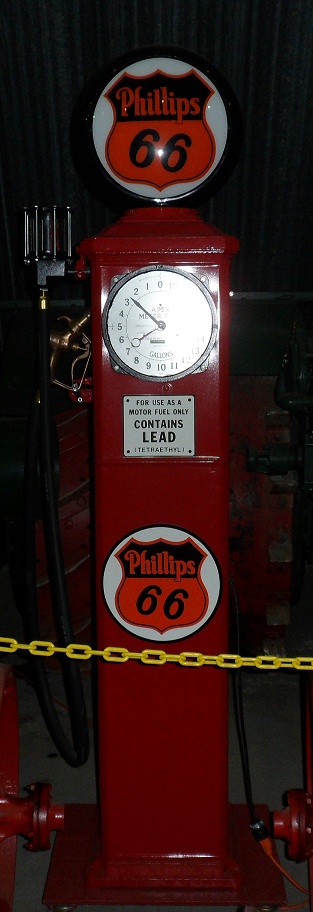
1930 #30 Apex clock face fuel dispenser
The National Oil Pump and Tank Company started in 1907. I found in one of my searches for the company that Dayton, Ohio city directories list Joseph N. Boesch as the president and treasurer of the company. The directories also show that in 1924, the company name had been changed to National Recording Pump Company and again in the 1930’s they would change their name one last time to the National Pump Corporation.


The National Pump Corporation would mark their place in history mainly because of their unique designs and their simplicity of their pumps that they produced during the late teens, and throughout the 1920s. The National Oil Pump and Tank Company were able to fend off the financial struggles that many companies were not able too. Thus National survived the depression. Mainly because they were small and were able to keep their assets in check, it also help that National produced a pump that their customer liked. They were simple in design and served their purpose for what they were need for. Many have become famous with collectors such as the Duplex, the Simplex, and the Apex. The National “Visibowls” are considered to be some of the best-looking visible ever made.
#30 Apex clock face
Other than the unique designs and the simplicity of their pumps, the company was just another pump company who made fuel dispensers, grease and oil dispensers and air-compressors. They would apply metering system designed by other companies, and then improving on those designs then apply it to their own pumps. National decided to move their offices too Cincinnati, Ohio in 1936. National would keep their manufacturing operations in Dayton Ohio. National was a small pump manufacturer and when the Tokheim Corporation approached them in 1948, National Pump Corporation would become part of Tokheim. In the years that followed Tokheim would use the National name on some of their pumps, but in the end the name National would be dropped from the companies’ fuel dispenser.  The one thing Tokheim corporation would keep was the national metering system it was of better design than what they were using and you can still find the national metering systems in Tokheim pumps today.


Below are just a few of the pumps that the National pump corporation designed and used. The Simplex, Duplex, Apex, Visibowls, and A series pumps, (A, A-1 and A-38) are highly sought after pumps.

Early pump models would feature the visible pump style, but it was the #70 10 gallon Visibowls was a multisided pump with six sides. That many consider this pump as a fancy pump. It featured a leaf design under the upper casting section that holds the visible in place. Arrows move up and down the inside of the cylinder to show the gallons being dispensed. This pump is a rare pump and highly prized in anyone’s collection. 

The #50 Duplex printer, this pump would print out the sale on a piece of paper it was manufactured in 1921. The pump was made of cast iron and would feature a clock face.

The #51 Duplex was a non printer, it too would feature a clock face and be made from cast iron.  

The # 61 Simplex was manufactured in 1925 and would also feature a cast iron body in the shape of an octagon and it also had a clock face.

The National #30 Apex clock face pump that is featured here at the Schwanke museum was built in 1930’s. It has a six foot gas hose with a banana nozzle and has a universal sight glass so that gas is made visible so the customer can see that the gas they were pumping into their car was clean.

Dirty gas was common in the early twentieth century, this was the reason many gas stations had visible pumps or pumps that feature a cylinder in which the gas could be seen.

 History is being lost every day and companies like the National Pump Corporation is one of the many pump manufacturing company that has been lost to history. Sure I had to dig a little bit to find the information that I have found. But there are so many things we have in the museum that I have not been able to find any information on. One day I going to photograph and post the picture on the blog, then if anyone has any information on any of those items it would make me happy and I will take that information and post it on this blog. Plus if you have any more information about items I have already posted let me know or if I have posted something in error. That way I can correct the information I posted.
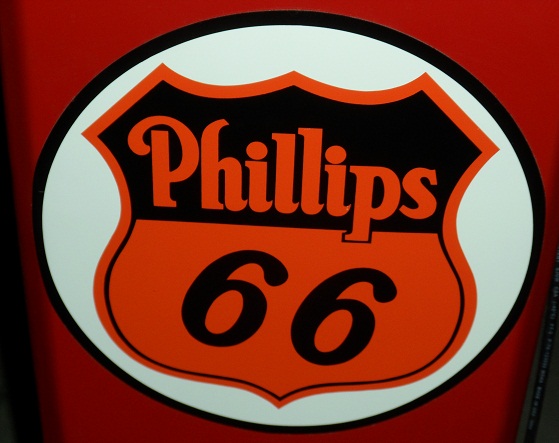
The original black and orange Pillips logo

Phillips Petroleum Company

 Phillips Petroleum Company was founded in 1917 by Frank and L.E. Phillips of Bartlesville, Oklahoma. Frank and L.E. Phillips they were considered two of the original experts in gas. They started prospecting for oil in 1903. Like most gas companies of the time Phillips became a supplier of gas, kerosene, fuel oil and refined oil products. The Phillips brother’s wanted their product to be different from their competitors. So they went about trying to improve the quality of their product. As history tells us the brother in 1927 took their newly developed high-octane gasoline and tested it on the mother of all roads Highway 66. While test driving their new formula they were able to reach a cruising speed of 66 mph. this was an achievement that no other company at the time was able to achieve. Inspired by the road signs and the ability to reach 66 mph, Phillips decided to name their new fuel Phillips 66.
I know I could leave it at this point proclaiming that is the history of Phillips 66 but there is so much more than just that.

Excited by their new product the brother decided to expand their business so on November 19, 1927, the Phillips brothers opened their first service station in Wichita, Kansas. The Phillips brother’s new gas was the talk of the county then the state people traveled from around the country to try their new fuel. So in 1929 the Phillips brothers would open their second service station and it would become their first station built in Texas in the city of McLean. Since then both stations have been preserved by local historical societies as historical sites and are visited by thousands of people every year.  

Taking inspiration from the new Highway 66 where they tested their new gasoline the Phillips brothers decided to design their shield log it was created for its link to the highway of the same number. The new logo was introduced in 1930, and it would have a black and orange color scheme and this logo would last for 30 years. In 1959, Phillips introduced a revised version of the shield in red, white and black, a color scheme still used by ConocoPhillips for the brand.
The New Logo used still today

One of the perks for stopping at a Phillips 66 during the late 1930s until the 1960s, Phillips would employ registered nurses as "Highway Hostesses," these nurses would make periodic and random visits to the Phillips 66 stations within their regions and these women would inspect the station restroom facilities to ensure they were well cleaned and stocked. These registered nurses or Highway Hostesses would also serve as ambassadors for the company by directing motorists to suitable dining and lodging facilities. Thus providing tourism for the cities that had a Phillips 66 station.
The Phillips Petroleum Company continue to introduce new products they were among the first oil companies to introduce a multi-grade motor oil, TropArtic, in 1954. These motor oils were designed to be used in automobile engines year-round. Unlike single grades which are recommended to meet variances in weather.

With their market expanding, Phillips Petroleum Company would work out a purchase agreement to add the Utah-based Wasatch Oil Company in 1946; and this would bring the Phillips 66 brand to the northern Rocky Mountain States and would reach as far as the eastern portions of Oregon and Washington. Phillips Petroleum Company would enter into the West Coast market in 1966, by purchasing Tidewater Oil Company's refining and marketing properties. Tidewater Oil company was the owners of the Flying A distributorships and after the buyout they would have to rebrand all of the service stations to Phillips 66. Phillips also had gasoline stations in Canada's western provinces of Alberta, British Columbia, Manitoba, and Saskatchewan under the name Pacific 66 until the late 1970s.

With their growing market share, Phillips Petroleum Company would become the nation's second oil company, after Texaco, to sell and market gasoline in all 50 states, by opening a Phillips 66 station in Anchorage, Alaska in 1967. However the Phillips' experiment in 50-state marketing was short-lived and the company would withdraw from the gasoline marketing in the northeastern U.S. in 1972. Still they are slowly returning to that market, there are Phillips 66 in Westport, Connecticut and Hadley, Massachusetts. In 1976, the Phillips Petroleum Company would sell their Tidewater properties on the West Coast to another company, the Oil & Shale Corporation (Tosco). Today, Phillips 66 primarily operates out of the Midwest and Southwest.

Still today, Phillips 66 stations are well represented at toll road concession areas in Kansas and Oklahoma.

The Phillips Petroleum Company used many advertising slogan in the mid-1970s , one of the slogans was "The Performance Company," not only promoting the performance of Phillips 66 gasoline and other petroleum products, they were also innovations with asphaltic materials, fertilizers and other non-automotive products. Other slogans through the years have included "Go First-Class — Go Phillips 66", "The Gasoline That Won the West", "Good Things for Cars and the People Who Drive Them" and "At Phillips 66 It's Performance That Counts".

Phillips Petroleum Company would purchase Tosco in 2000, and this would include the Circle K convenience stores and Union 76 gasolines. Phillips Petroleum Company would merge with Conoco to form ConocoPhillips, in 2002. The merged companies would go on to market their gasoline and other products under the Phillips 66, Conoco and 76 brands. ConocoPhillips would also go on to license the Phillips 66 brand to Suncor Energy for its Phillips 66 branded stations in Colorado.

For a small company that was started by two brothers in 1917, with a passion to produce a cleaner more efficient fuel. The Phillips Petroleum Company has come a long way to be one of the great petroleum producers to date. 


Thursday, June 30, 2011

Wayne fuel dispensers, Cities Service and Pure Oil Companies

Wayne Dial face with computedf metering 

Pure Oil Company

There have been three companies that have operated in the US that have used the Pure Oil name. The first Pure Oil began as a group of independent oil refiners, producers, and pipeline operators, from Butler, Pennsylvania headquartered in Pittsburgh, even though the company was incorporated in New Jersey in fall 1895. The Pure Oil Company came about because of the dominance of the Standard Oil Company in the Pennsylvania oil fields and it was organized by independent interests to counter the dominance. Pure Oil was the second vertically integrated oil company (after Standard) in the region. The operations were based in Oil City, Pennsylvania. In 1896 David Kirk would be elected as the first president but was succeeded by James W. Lee in 1896.

 In 1900, Pure Oil would become a holding company for three independent pipeline companies. Pure Oil Producing Co. was incorporated into the company in1902 and by 1904 pure had finished a refinery which had been built on the Delaware River and would receive 600 barrels a day from the United States Pipe Line, Which would increase to 1800 barrels a day by 1906. When Pure Oil would ship their oil to Europe they would use Penn oil tanker to deliver their product.

One of the products that Pure Oil sold to Philadelphia and to New York City was illuminating oil (kerosene) and Standard Oil was their major competitor on the east coast. Pure Oil also built bulk terminals in Amsterdam and Hamburg; they wanted to compete with Standard Oil in Europe. By 1917 Pure Oil had over extended its operations in Europe so they ended their operations.

By this time Cities Gas Company a Columbus-based Ohio Oil Company had begun to make offers to buy out the company and made an offer of $24.50 a share to buy out the company. Cities Gas Company was building a refinery in Oklahoma, and Pure Oil had production capabilities that would benefit this company. So in 1917 the Pennsylvania company accepted the offer and made $22 million in profit on the sale.

In 1920, Ohio Cities Gas Company's would change its name to Pure Oil. In 1926, Pure Oil headquarters would move to Chicago. The Company now had refineries that were located in Ohio, West Virginia, Oklahoma, and Texas. One of the first Pure Oil Gas Station was built in 1933 and located in Saratoga Springs; New York and it was registered in 1978 with the National Register of Historic Places. Pure Oil ranked as one of the country's 100 largest industrial companies in the 1960s sales were over $700 million a year. The company employed over 1000 people just in the Chicago area. The company motto was "Be sure with Pure." that motto was used because it was said that some filling stations and oil companies were adding water and chemicals into their fuels and Pure wanted to assure their customer that they were getting the very best product.

Union Oil Company of California would make an offer and purchase Pure Oil in 1965. Shortly after the acquisition by Union Oil it would change the name of Pure Oil's Refining & Marketing operations to the Pure Oil Division of Union Oil Company of California with the Pure Oil name continuing in full force. When the 1970s came along the Pure Oil brand would be phased out and the remaining service stations, auto and truck stops would be rebranded as Union 76. The Pure Oil Division would fully merge with Union Oil's west coast Refining & Marketing division and become the Union 76 division. The Pure Oil name was still retained as a registered trademark and used the Firebird brand name primarily for motor oils and lubricants that were not extensively marketed toward consumers. In 1992, Unocal would announce their plans to end Southeast operations. The Pure Oil lives on as part of Unocal still today.


The Cities Service show below belonged to Ed Gesch Farm. Most of the town of Willmar, MN. is built on that farm. This pump is just one of the few items that were purchased from the farm.

Glass Fuel Cylinder with Ten Gallon Indicators

1920's Base and Body features hand pump to dispense gasoline

Wayne name plate

Certification plate features Model number 519 and Serial number 27802

Body and Pump Handle

Fill Pipe for either above ground or under ground storage tanks

nossel


The Wayne Pump Company
Fort Wayne Indiana
The Wayne pump company was founded in 1891 by employees of the S.F. Bowser of Fort Wayne, Indiana,. The company had a hard time deciding on an official name, sometimes advertising as the Wayne Oil Tank & Pump Company and the Wayne Tank & Pump Company. It wasn’t till 1928 the company began using the name Wayne Pump Company. Until then they used the name Wayne Oil Tank Company they began producing retail kerosene storage tank and pump combination for use in hardware and grocery stores to dispense kerosene. In 1907, they began production of gasoline pumps, and in 1918, they introduced what is considered to be the first true visible pump Model 276v. Wayne concentrated on production of visible gas pumps throughout the 1920. by 1928 the now newly named Wayne Pump Company had purchased Fry equipment and Boyle Dayton manufacturing and was ready to introduced the first clock face metering pump. Despite the many innovations, the Wayne Pump Company was near the point of bankruptcy and what saved the company was the invention of the computing mechanism that became industry standard for all gasoline dispensing equipment for the next 50 years. Wayne Pump Company licensed the computer to Veeder-Root manufacturing in 1934, the company was from Hartford, Connecticut, Veeder-Root manufactured gauges and metering devices and the Veeder-Root computer was made available to other pump manufacturers with-in a year or two. The Wayne Pump Company was never really given the credit that they deserved for their innovation. The timing was just right for the invention, that and a few new pump designs was what saved the company.
In 1951 Wayne Pump Company took a step forward and purchased an interest in the Martin & Schwartz pump operation. They were a division of Symington-Gould who were one of the industrial and railroad components manufacturer . The majority owners insisted the gas pump manufacturing operations would be consolidated in the Salisbury, Maryland.
The Wayne Pump Company merged in 1958 with the Symington-Gould to form Symington-Wayne. Some of the innovations that took place in this era included the development if the first twin pump using one single-width 500 series cabinet it was the first to have two complete pump systems combined. Sun Oil pioneered the first blending system, Wayne being the innovators that they were built the first custom blender model 511 in 1956 in conjunction with Sun Oil and introduced at few selected Sunoco stations in Buffalo New York, Indianapolis, and Norfolk, Virginia. Wayne developed a new cabinet design and a new model 511D and this new design was also use with the custom blenders at Sunoco stations throughout the east.
Dresser Industries the industrial giant absorbed the Symington-Wayne into it fold in 1968 and separated the service station equipment business from other their other manufacturing pursuits. Dresser Wayne would once introduced a new innovation with the first electronic gasoline dispensing equipment to their lineup of innovations in 1975. Dresser Wayne ceased operations in Salisbury, Maryland in 2001 and moved it’s operations to Austin, Texas where even today Dresser Wayne is still one of the leading innovator and one of the leading manufacturers of retail petroleum equipment. Dresser Wayne pumps can be found in many modern stations today.


Cities Service

 Oil entrepreneur Henry Latham Doherty started Cities Service in the early 1900s. Doherty would quickly become a leader in the manufacturing of gas and electric utilities. Doherty created his own organization, Cities Service Company in 1910, to supply gas and electricity to small public utilities. Doherty began by acquiring gas producing properties, then moved on to acquire distributing companies and tied them into a common source of supply. The company then developed a pipeline system, tapping dozens of gas pools. This was to make the gas available to its consumers. Cities service developed a plan to use slack demand periods to refill their depleted fields near their customer base. This way gas could be inexpensively withdrawn during peak demand. Cities service was the first company in the mid-continent to use this method.

Doherty being the business man that he was decided the next logical step was to develop a program to find and develop supplies of natural gas that would help his company move into the oil business. By doing this it would mark a major discovery in Augusta, Kansas in 1914 and later that year in El Dorado. Cities Service subsidiary, Empire Oil & Refining discovered the Oklahoma City field, one of the world's largest. They would also participate in the discovery of the East Texas field, which, in its time, was the most sensational on the globe. Cities Service would also go on to completed the nation's first long-distance high pressure natural gas transportation system in 1931. It was a 24-inch pipeline that would stretch some 1,000 miles from Amarillo, Texas, to Chicago, Illinois.

 At the height of Cities Service's growth, Congress would go on to pass the Public Utility Holding Company Act of 1935. This would force Cities Service to change itself of either being utility operations or get rid of its oil and gas holdings. The decision was difficult but Cities Service elected to remain in the petroleum business. The first step was to liquidate investments in its public utilities which took place in 1943. This would affect over 250 different utility corporations.


Around the same time the US government was almost at completion of a major refinery at Rose Bluff near Lake Charles, Louisiana. This refinery would eventually become the foundation of the company's manufacturing operation. The government would use designs that were developed by Cities Service and the Kellogg Co., the plant would be dedicated only 18 months after the first concrete was poured. The refinery would open a month before Allied troops would land in France; the refinery would turn out enough of the critically needed 100-octane aviation gasoline that the bombers would need to fuel the 1,000 daily bomber sorties that would take off from England to Germany. With enough Government funding through the Defense Plant Corporation (DPC) also prompted Cities Service to build plants to manufacture butadiene which is used to make synthetic rubber, and toluene, which is a fuel octane booster and solvent. In the years that follow Cities Service would see growth and become a fully diversified oil and gas company with operations around the world.

Cities Service Company first inaugurated use of the CITGO brand would happen in 1965 (officially styled "CITGO") was used for its refining, marketing and retail petroleum businesses which became known inside the company as the RMT Division, for Refining, Marketing and Transportation. CITGO would continued to be used only a trademark, and not the companies name until it was sold 1983 to what had been the RMT Division of Cities Service to Southland Corporation. Eventually Southland Corporation would sell 50 percent of CITGO holdings to PetrĂ³leos de Venezuela in 1986 and would acquire the remainder in 1990 which would result in the current ownership structure.

Thursday, June 16, 2011

A.O.Smith

1963 A.O. Smith fuel dispenser


dial face of the A.O. Smith pump

Side view of pump which features 6' hose and banana nozzle with auto shutoff system.

Front view of pump featuring RED CROWN GASOLINE and dial face.


Dial face of  an A.O.Smith fuel dispenser.
Smith Meter Systems (1937 - 1976)

R.Stanley Smith founded the Smith Meter Systems. His company manufactured petroleum meters, Valves, and related oilfields equipment as well as gasoline dispensing pumps. The original Smith Meter Company was founded in Los Angeles, Calif., in 1937. Smith meter acquired Neptune Meter in (1948). Neptune meter was a manufacture of service station pumps. In (1955) Smith acquired Erie Meter Systems Inc. (1958) Consolidated operations into the meter and service station divisions. Later changing the name to A.O. Smith - Erie Division.

Erie Meter (1922 - 1958)

Erie start selling gasoline pumps under the name of "Erie Service Station Equipment Company." Erie meter produced their first pump in 1922. In 1927 Erie shorten their name to "Erie Meter Systems Inc." Their early pumps were encased in masonry housings, then in cabinets that looked like masonry housings. Erie produced a great number of clock meter pumps, in 1930 Erie manufactured only one visible gasoline pump design. 100 were made and are very collectible today. Erie also made Art Deco pumps in the mid - 30's and they too have become very collectible today. Erie also manufactured oil dispenser, air compressors, air towers, and greasing equipment. In 1958 Erie merged with A.O. Smith Company.

A.O. Smith Company (early 1900's)

Smith started business in the early 1900's as a supplier of petroleum Equipment, like oil drilling equipment, transportation platforms and pumps. A.O. Smith bought out his nephew R. Stanley Smith, then added Neptune Pumps, (1948), then Erie Pumps, (1955). Today A.O. Smith is in Milwaukee, Wisconsin. A.O. Smith Corporation still manufactures water pumps, Aqua pumps, and Commercial Water Heaters.

In 1976 A.O. Smith sold their Meter and Service Station Equipment Division to GeoSources Inc. of Houston, Texas.

The pump shown above features RED CROWN GASOLINE a product of STANDARD OIL COMPANY.

"Like most companies, Standard Oil started small. Unlike most companies, however, it had the backing of a big name in American industry, John D. Rockefeller.

Standard Oil of Indiana, as the company was officially known for many years, took shape in 1899. Initially it consisted of a single facility outside Whiting, Indiana, which refined oil intro products that people and business needed: axle grease for industrial machinery, paraffin wax for candles, kerosene for home lighting.

The company grew. By the early 1900s it was the leading provider of kerosene and gasoline in the Midwest. Kerosene sales would eventually falter. But with car ownership booming across the United States, demand for gasoline would only go up and up." <<< taken from the bp website that features the history of the standard oil company along with the Amoco history. I am also posting the web address here. >>>> www.bp.com/